Back
Customer Satisfaction Surveys: How to Ask Better Questions and Turn Feedback Into Action

Matthieu Saussaye


Customer satisfaction surveys often produce plenty of data but very few decisions.
A company sends a questionnaire after a purchase, support interaction or subscription renewal. Customers select a score, perhaps leave a comment, and the results are added to a dashboard. The team tracks whether the score rises or falls—but may still not understand what caused the change or what to improve next.
A useful customer satisfaction survey must do more than measure whether customers are happy. It should reveal:
Where customers experience friction
Which parts of the experience matter most
Why satisfaction differs across customer segments
What should be improved first
Whether previous changes have worked
This matters as customer expectations continue to increase. Zendesk’s 2026 research reports that 88% of customers expect faster response times than they did one year earlier, while 74% expect customer service to be available around the clock.
This guide explains how to design a customer satisfaction survey that generates reliable, specific and actionable insights, not just another score.
What Is a Customer Satisfaction Survey?
A customer satisfaction survey is a structured questionnaire used to understand how customers perceive a company, product, service or specific interaction.
It can measure satisfaction at two different levels:
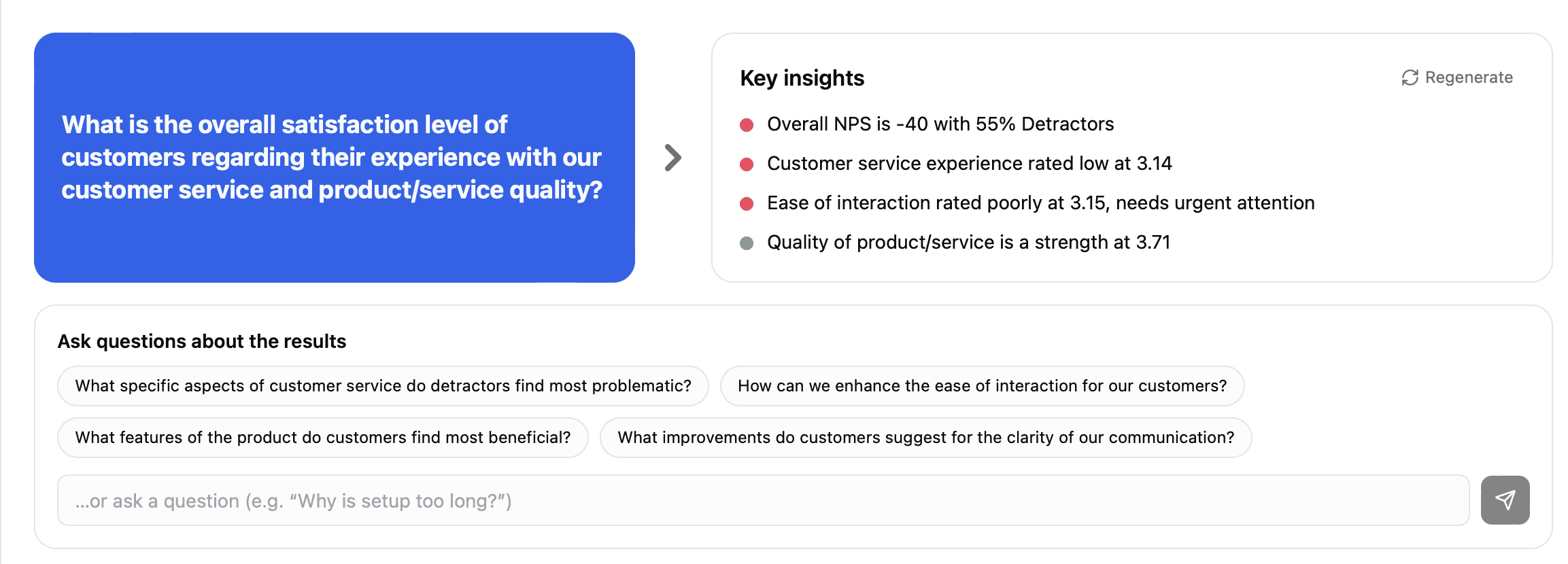
Transactional satisfaction evaluates a particular moment, such as a purchase, delivery, onboarding process or customer support conversation.
Relationship satisfaction evaluates the customer’s broader experience with the company over time.
The distinction is important. A customer may be satisfied with a recent support interaction but unhappy with the product itself. Another customer may experience a delayed delivery but relmain loyal because of a strong long-term relationship with the brand.
Customer satisfaction should therefore be measured as a system rather than through a single isolated question. ISO 10004 provides guidelines for establishing ongoing processes to monitor and measure customer satisfaction, emphasizing that satisfaction measurement should be integrated into organizational decision-making. The current edition was reviewed and confirmed in 2023.
Why Customer Satisfaction Surveys Matter
A well-designed survey can help a company:
Detect problems before they lead to churn
Improve products, services and support processes
Identify the moments that influence loyalty
Compare satisfaction across customer segments
Evaluate changes to pricing, features or communications
Prioritize investments based on customer impact
Discover unmet customer needs
Track the customer experience over time
However, these benefits only appear when the survey is designed around a clear decision.
Before writing any questions, complete this sentence:
“We will use the results of this survey to decide whether or how to ______.”
For example:
Improve the onboarding process
Redesign the returns experience
Reduce customer support friction
Prioritize the next product improvements
Understand why satisfaction has declined
Improve customer retention among new subscribers
Before creating your survey
Complete this sentence:
“The results of this survey will help us decide…”
If your team cannot complete it precisely, the survey objective is probably still too broad.
Customer Satisfaction Metrics: CSAT, NPS and CES
Customer satisfaction is usually measured using three complementary metrics.

Where I draw the line between AI-led and human research
I let AI do the scaffolding: map the decision statement to CSAT, NPS or CES, suggest transactional vs relationship timing, draft and dedupe driver questions from journey data and tickets, and run sample checks. It also segments respondents, clusters verbatims, and estimates driver importance, so we can simulate how a fix to onboarding or returns could move the score.
I keep a human on objective definition, wording, sampling and consent, and on interpreting causality and trade-offs. They verify that driver items map to levers we own and design follow-up experiments. One failure when the line is crossed: an auto-optimizer softens CSAT/CES wording, inflates scores, and the roadmap chases noise while true friction persists.
Matthieu Saussaye, Founder of SmartInterview. Written from the studies we run on SmartInterview, not from a content brief.
Customer Satisfaction Score: CSAT
CSAT measures satisfaction with a company, product, service or interaction.
A typical CSAT question is:
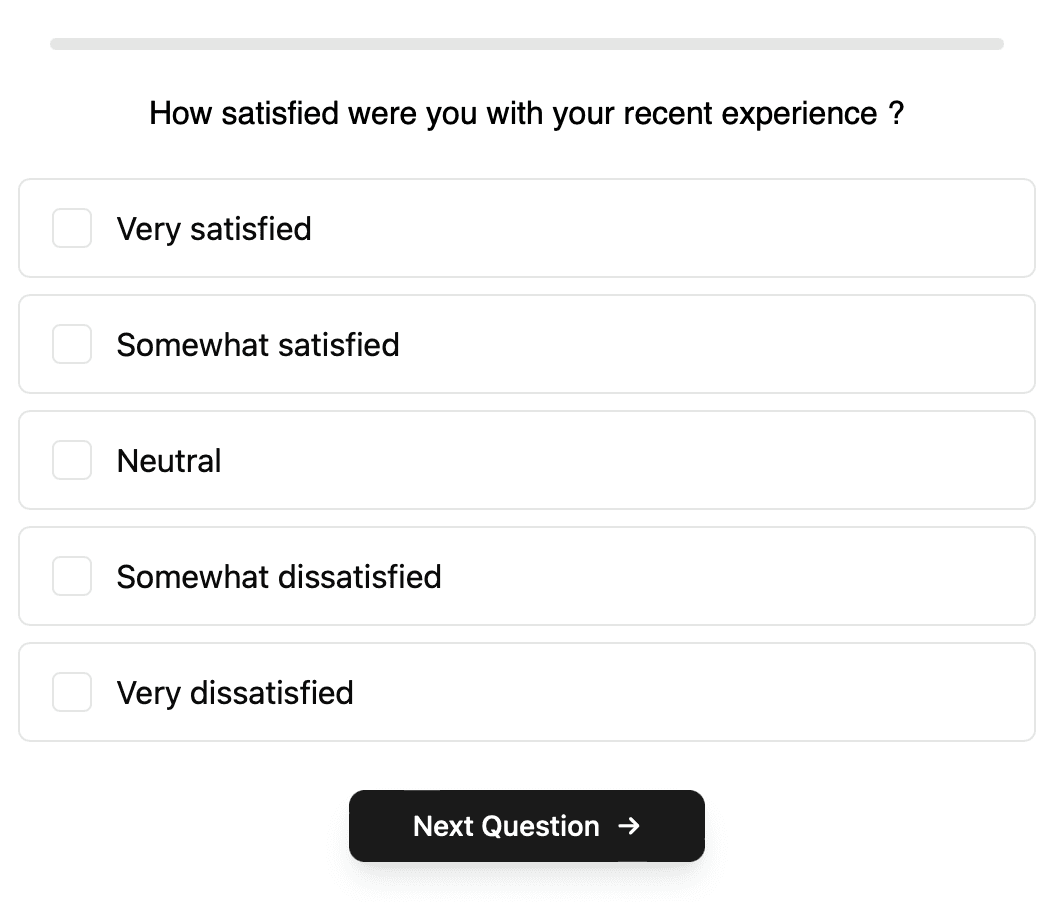
How satisfied were you with your recent experience?
Respondents usually answer on a five-point scale:
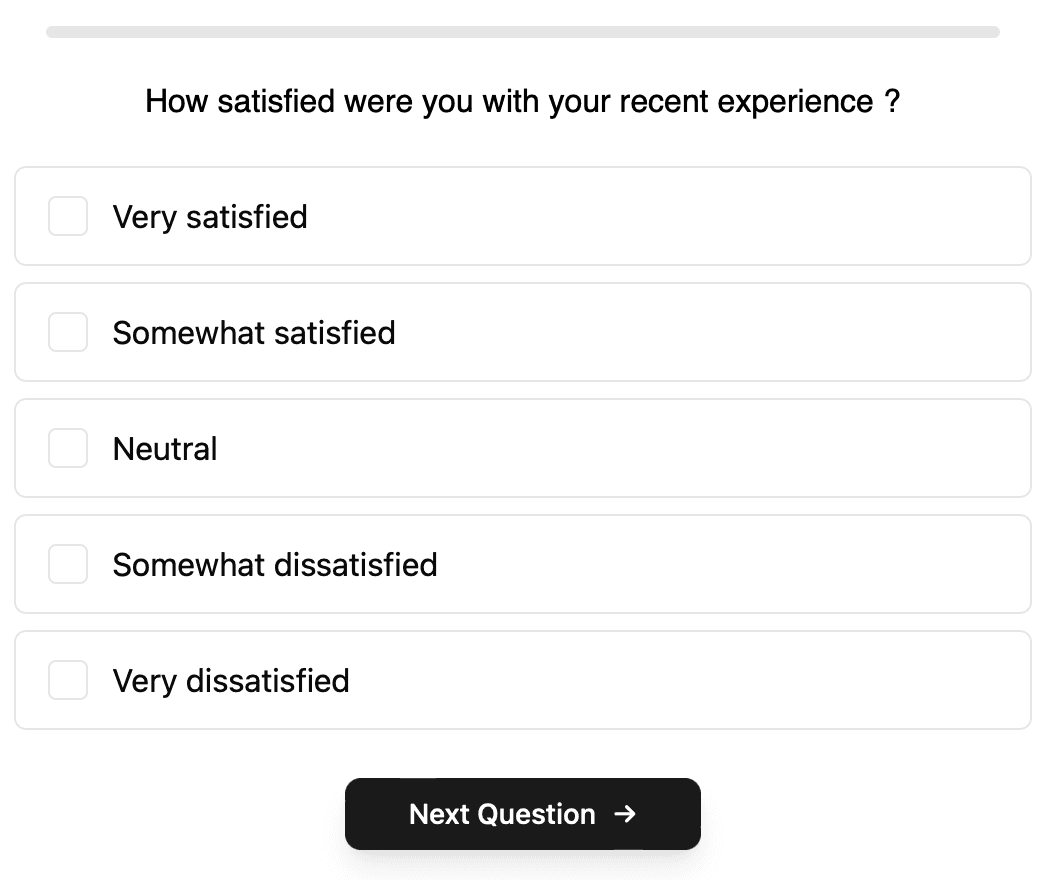
The standard calculation is:
CSAT = Number of satisfied and very satisfied respondents ÷ Total number of valid respondents × 100
For example, if 160 of 200 respondents select “satisfied” or “very satisfied”:
CSAT = 160 ÷ 200 × 100 = 80%
Net Promoter Score: NPS
NPS measures the strength of the overall customer relationship through the question:
How likely are you to recommend our company to a friend or colleague?
Customers answer from 0 to 10 and are classified as:
Promoters: 9–10
Passives: 7–8
Detractors: 0–6
The score is calculated as:
NPS = Percentage of promoters − Percentage of detractors
Customer Effort Score: CES
CES measures how easy or difficult it was for a customer to complete an action.
A typical question is:
How easy was it to resolve your issue today?
CES is useful for processes such as:
Completing a purchase
Setting up an account
Finding information
Returning an item
Resolving a support request
Which Customer Satisfaction Metric Should You Use?
Objective | Recommended metric |
Evaluate a specific interaction | CSAT |
Measure the overall relationship | NPS |
Identify friction in a process | CES |
Understand the reasons behind a score | Open-ended follow-up |
Prioritize improvements | Driver questions and segmentation |
You do not need to include all three metrics in every survey. Select the metric that matches the decision you need to make.
When Should You Send a Customer Satisfaction Survey?
Survey timing affects both recall and relevance.
After a purchase
Send the survey when the customer has had enough time to receive and use the product.
After a customer support interaction
Send the survey shortly after the conversation or issue has been closed.
After onboarding
Trigger the survey after the customer has completed key onboarding steps or had enough time to experience the process.
After a product milestone
For a SaaS product, useful milestones might include:
Completing the first project
Using a core feature
Reaching 30 days of activity
Upgrading a subscription
Canceling or reducing usage
At regular intervals
Relationship surveys can be sent quarterly, biannually or annually to track broader changes.
How to Build an Effective Customer Satisfaction Survey
1. Define one primary objective
A survey about “the overall customer experience” is usually too broad.
Choose a precise objective, such as:
Understand why new customers struggle during onboarding
Identify the main causes of low post-delivery satisfaction
Evaluate the quality of customer support
Determine which product improvements would increase retention
2. Identify the experience you are measuring
Specify:
Which customer
Which interaction
Which product or service
Which time period
Instead of asking:
How satisfied are you with our services?
Ask:
Thinking about the support conversation you completed today, how satisfied were you with the resolution provided?
BONUS
30 Customer Satisfaction Survey Questions
A visual showing the five categories:
Overall satisfaction
Product experience
Customer service
Onboarding
Purchase and delivery
Overall satisfaction questions
Overall, how satisfied are you with your experience with [company]?
How satisfied are you with [product or service]?
To what extent did your experience meet your expectations?
How would you rate your experience compared with similar alternatives?
What was the main reason for your rating?
Product satisfaction questions
How satisfied are you with the overall quality of [product]?
How well does [product] meet your needs?
How easy is [product] to use?
How satisfied are you with the reliability of [product]?
Which part of [product] provides the most value?
What is the most important improvement we could make?
Is there anything you expected [product] to do that it does not currently do?
Customer service questions
How satisfied were you with the support you received?
How easy or difficult was it to contact us?
How satisfied were you with our response time?
How clearly did our team communicate with you?
To what extent was your issue resolved?
How much effort did you personally have to make to resolve your issue?
What could we have done to resolve your issue more effectively?
Onboarding questions
How easy was it to get started with [product or service]?
How clear were the onboarding instructions?
How quickly were you able to achieve your first useful result?
At which stage, if any, did you experience difficulty?
What additional guidance would have been useful?
Purchase and delivery questions
How easy was it to complete your purchase?
How satisfied were you with the information provided before purchase?
How satisfied were you with the delivery experience?
Did your order arrive when expected?
How satisfied were you with the condition of your order?
What could we improve about the purchase or delivery experience?
Customer Satisfaction Survey Template
Use this template
Create Customer Satisfaction Surveys With SmartInterview
SmartInterview helps teams design, review and analyze customer satisfaction surveys with AI.
You can use it to:
Generate a questionnaire from your research objective
Detect leading, ambiguous or double-barreled questions
Improve survey quality before launch
Ask intelligent follow-up questions
Analyze open-ended customer feedback
Identify themes, friction points and unmet needs
Compare insights across customer segments
Turn survey responses into clear conclusions
Turn customer feedback into clear decisions
Create a customer satisfaction survey, improve its methodology and automatically analyze every open-ended response.
Frequently Asked Questions
What is a customer satisfaction survey?
A customer satisfaction survey measures how customers perceive a company, product, service or specific interaction.
What is a good CSAT score?
There is no universal good CSAT score. Compare results with your historical performance and genuinely comparable industry benchmarks.
How many questions should a customer satisfaction survey include?
A short transactional survey may need only five to eight carefully selected questions.
What is the best customer satisfaction question?
A reliable general question is:
Overall, how satisfied were you with [specific product, service or interaction]?
What is the difference between CSAT and NPS?
CSAT measures satisfaction with an experience. NPS measures the broader customer relationship and likelihood to recommend.
When should a CSAT survey be sent?
Send it soon enough for the customer to remember the experience, but after they have had sufficient time to evaluate it.
Should customer satisfaction surveys be anonymous?
Anonymous responses can encourage candid feedback, while identified responses allow individual follow-up. The right approach depends on the survey objective.
SmartInterview: Smarter Customer Satisfaction Surveys
Whatever the size of your business, understanding customer satisfaction is essential to improving the customer experience and strengthening loyalty. CSAT, NPS, and CES surveys help you identify key moments in the customer journey, quickly detect pain points, and better understand your customers’ expectations.
With SmartInterview, you can easily create a survey tailored to your objectives using ready-made templates, AI-generated questions, and methodological recommendations. You can then customize each study according to your industry, audience, and the specific touchpoints you want to evaluate.
SmartInterview supports you throughout the entire process, from questionnaire design to response analysis. Open-ended questions can be explored through intelligent follow-up questions, customer feedback is analyzed using AI, and the main insights are automatically summarized to help you make better decisions faster.
Net Promoter, Net Promoter Score, and NPS are trademarks of Satmetrix Systems, Inc., Bain & Company, Inc., and Fred Reichheld.

