Find the message that convinces your buyers before the campaign runs

Campaign messages are usually chosen by the team that wrote them. The first real test is the campaign itself, when the media budget is already spent.

No credit card50 free respondentsGDPR & CCPA compliant

Message testing shows candidate claims, headlines or ads to your target audience and measures clarity, credibility and appeal, so you launch the version most likely to work.

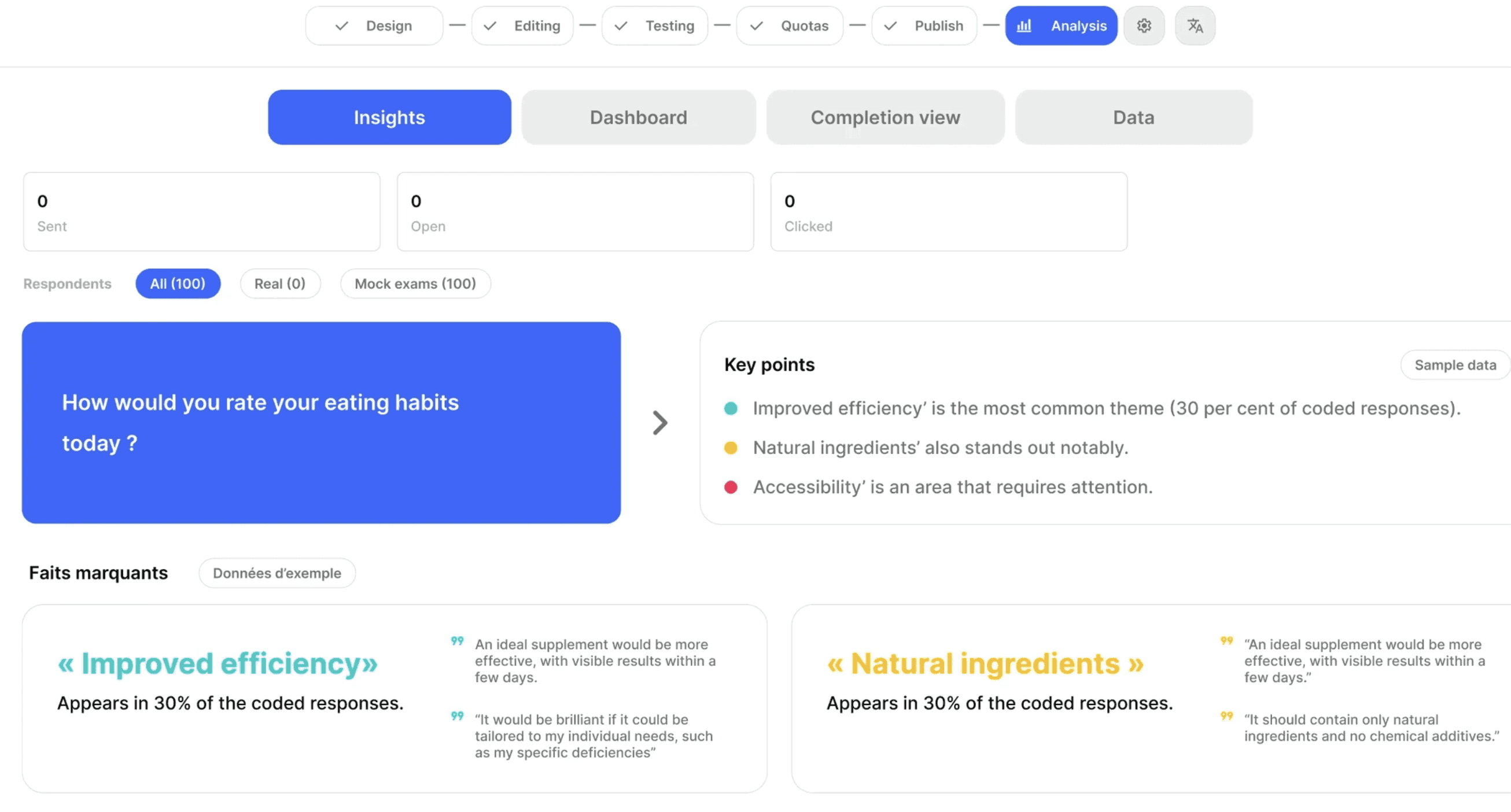
SmartInterview asks each respondent which words convinced them and which ones raised doubts, and codes the answers into themes you can compare.

Why message testing matters

The same product can win or lose on one sentence. Testing messages costs a fraction of the media plan it protects.

  • Pick the strongest claim among several drafts
  • Remove words that confuse or reduce credibility
  • Adapt the message per market and language
  • Settle internal debates with customer evidence

How it is done today, and with SmartInterview

TodayWith SmartInterview
The team that wrote the claims also picks the winnerTarget buyers rate each claim on clarity, credibility and appeal
A/B tests run on live media, budget spent before learningClaims compared before launch, with a second round after rewording the same week
Scores show which claim lost, never which word hurt itAI follow-ups ask which words convinced or raised doubts, coded into themes
One translated message assumed to work in every marketEach market answers in its own language, themes consolidated across languages

What you can learn from message testing

Which message wins

Clarity, credibility, relevance, uniqueness and purchase intent per message, then a ranking or forced choice so not every option scores well.

Which words work

After each rating the AI asks what exactly made the message believable or not. Recurring phrases are coded into themes.

Differences between audiences

A claim that convinces one segment can put off another. Results are split by segment and market.

How message testing works

  1. 1

    Define your research objective

    List the options to decide between: claims, headlines, taglines, ads, emails or packaging copy.

  2. 2

    Create the survey

    Show each message as text or image. The questionnaire measures clarity, credibility and appeal, with a ranking at the end.

  3. 3

    Recruit respondents

    Reach the segments the campaign targets, in their own language.

  4. 4

    Analyze quantitative and qualitative insights

    Read the ranking, the words to keep, the words to cut and the verbatims that prove it.

Example studies

SmartInterview analysis of coded open answers
Illustrative study design

Choosing a claim for a new product page

Challenge

A team has four candidate headlines for a product launch and cannot agree internally.

Research design

Each respondent rates two headlines on clarity, credibility and appeal, then ranks all four. The AI asks what made the top choice convincing.

Respondents

About 150 people per target segment, from the customer list and a panel partner.

Business decision

Launch with the most credible headline, reworded without the technical term.

Key insights

  • One headline leads on credibility, another on appeal
  • A technical term reduces clarity for new customers

Message testing topics teams search for

MaxDiff for message testing

MaxDiff shows small sets of messages and asks which is most and least convincing, repeated across combinations. It produces a clear ranking even with many claims, because respondents cannot rate everything highly.

How to test a value proposition

Write each value proposition in one or two sentences stating the benefit and who it is for, then measure relevance, clarity and difference from alternatives. Ask respondents what they think the product does, to check the message is understood as intended.

Claim testing vs claim substantiation

Claim testing checks whether a claim persuades, while substantiation proves it is true and legally defensible. You need both: a convincing claim you cannot support creates legal risk, and a supported claim nobody believes wastes the media plan.

Ad pre-testing

Ad pre-testing shows a draft ad, storyboard or script to the target audience before production or media spend, measuring comprehension and persuasion. SmartInterview can show the ad as an image or text and ask respondents what they took away from it.

How to measure message credibility

Ask how believable the message is on a scale, then ask what would make it more believable. Low credibility usually points to a missing proof point, an exaggerated number or a claim that sounds like every competitor.

Testing messages with different audiences

Split results by the segments the campaign targets, such as current customers and prospects. A message that reassures existing buyers can sound generic to newcomers, and quotas per segment keep each group large enough to compare.

Message testing vs A/B testing

A/B testing measures behaviour on live traffic and needs volume and time, while message testing asks the audience directly before launch. Use message testing to shortlist the strongest claims, then A/B test the finalists in market.

Packaging copy testing

Packaging text is read in seconds on a shelf, so show it as it appears on the pack, not as a sentence in a survey. Ask what respondents remember and which claim would make them pick the product up.
Pricing

Choose your respondent volume

Pro and Ultimate prices update instantly as you change the number of respondents per month.

300 respondents / month
CHF 79
Pro / month

FREE

CHF050 respondents included
  • 1 member
  • 50 respondents
  • Automated survey design
  • AI-powered analysis & dashboard
  • Share surveys via link, WhatsApp or QR code
Get started for free
RECOMMENDED

PRO

CHF79/ month

starting at 150 respondents

  • Everything in Free, plus:
  • Access to 300 respondents per month
  • Up to 3 members
  • Email invitations
  • Client / externals collaboration
  • AI-powered analysis of open-ended responses
Get started· CHF 79

ULTIMATE

CHF149/ month

starting at 500 respondents

  • Everything in Pro, plus:
  • Access to 500 respondents per month
  • Up to 5 members
  • Qualitative interview transcription
  • Advanced coding & categorisation
  • Company branding
  • Remove SmartInterview branding
  • Executive report with results (PDF)
Get started· CHF 149

ENTERPRISE

Let's talk
  • Everything in Ultimate, plus:
  • Unlimited members
  • Custom respondent volumes
  • Custom integrations
  • Dedicated support
  • Security & procurement review
Contact us

Whether you collect one respondent this month or ten next quarter, you only pay for what you use. Your respondent credits are valid for 3 years.

Frequently asked questions

Message testing is research that shows candidate marketing messages to a target audience and measures how clear, credible and appealing they are, to choose the most effective one before launch.

Claims, headlines, taglines, value propositions, ads, emails, landing page copy and packaging text, as text or images.

One at a time gives clean scores per message. Side by side, with a ranking or forced choice, shows which one wins. Many studies combine both.

Clarity, credibility, relevance, uniqueness and purchase intent, each followed by an open question on what drove the score.

About 100 to 150 per audience segment is usually enough to see a clear winner and its reasons.

Translate the messages, let each respondent answer in their own language, and consolidate the themes across markets.

Concept testing evaluates the product idea. Message testing evaluates how you describe it.

The first 50 respondents are free. Paid plans start at CHF 45 per month for 150 respondents per month.

A short test can be live the same day, which leaves time for a second round after rewording.

Know which message wins before you pay for media

Bring the claims you are debating internally and let your audience settle it this week.

No credit card50 free respondentsGDPR & CCPA compliant