Learn why buyers choose your competitors, and what would make them switch

Competitor analysis usually means comparing websites and feature lists. It says little about why buyers actually pick one brand over another.

No credit card50 free respondentsGDPR & CCPA compliant

Competitor research asks buyers in your category which brands they consider, what they value in each and what would make them switch, so positioning is based on buyers, not on a feature grid.

SmartInterview measures consideration and preference across brands, then asks each respondent why, and codes the reasons by brand.

Why competitor research matters

You win customers from competitors, not from an empty market. Knowing why they choose someone else tells you what to change and what to say.

  • See which competitors are actually considered
  • Find the attributes where each brand wins
  • Understand the barriers that stop switching
  • Build positioning on a real point of difference

How it is done today, and with SmartInterview

TodayWith SmartInterview
Feature grids compared from competitor websites, buyers never askedCategory buyers explain which brands they consider and why, coded by brand
Win-loss reasons guessed by sales from a few lost dealsBuyers who chose a competitor explain the decisive reason in their own words
Competitors' customers are hard to reach without an agencyA panel partner reaches category buyers screened on the brand they use today
Switching barriers are assumed, never measuredSwitching intent measured, with AI follow-ups surfacing the barriers that keep buyers loyal

What you can learn from competitor research

The consideration set

Which brands buyers know, consider and prefer, and how your brand compares at each step.

Why buyers prefer a competitor

The reasons behind each preference, coded by brand, so you see where each competitor is strong.

What would make them switch

The conditions, features or prices that would move a competitor's customer to you, and the barriers that keep them.

How competitor research works

  1. 1

    Define your research objective

    Name the competitive question: positioning, switching, pricing gap or a competitor's launch.

  2. 2

    Create the survey

    List the competitors to include. The questionnaire covers awareness, consideration, preference and switching.

  3. 3

    Recruit respondents

    Reach category buyers, including competitors' customers, through your list or a panel partner.

  4. 4

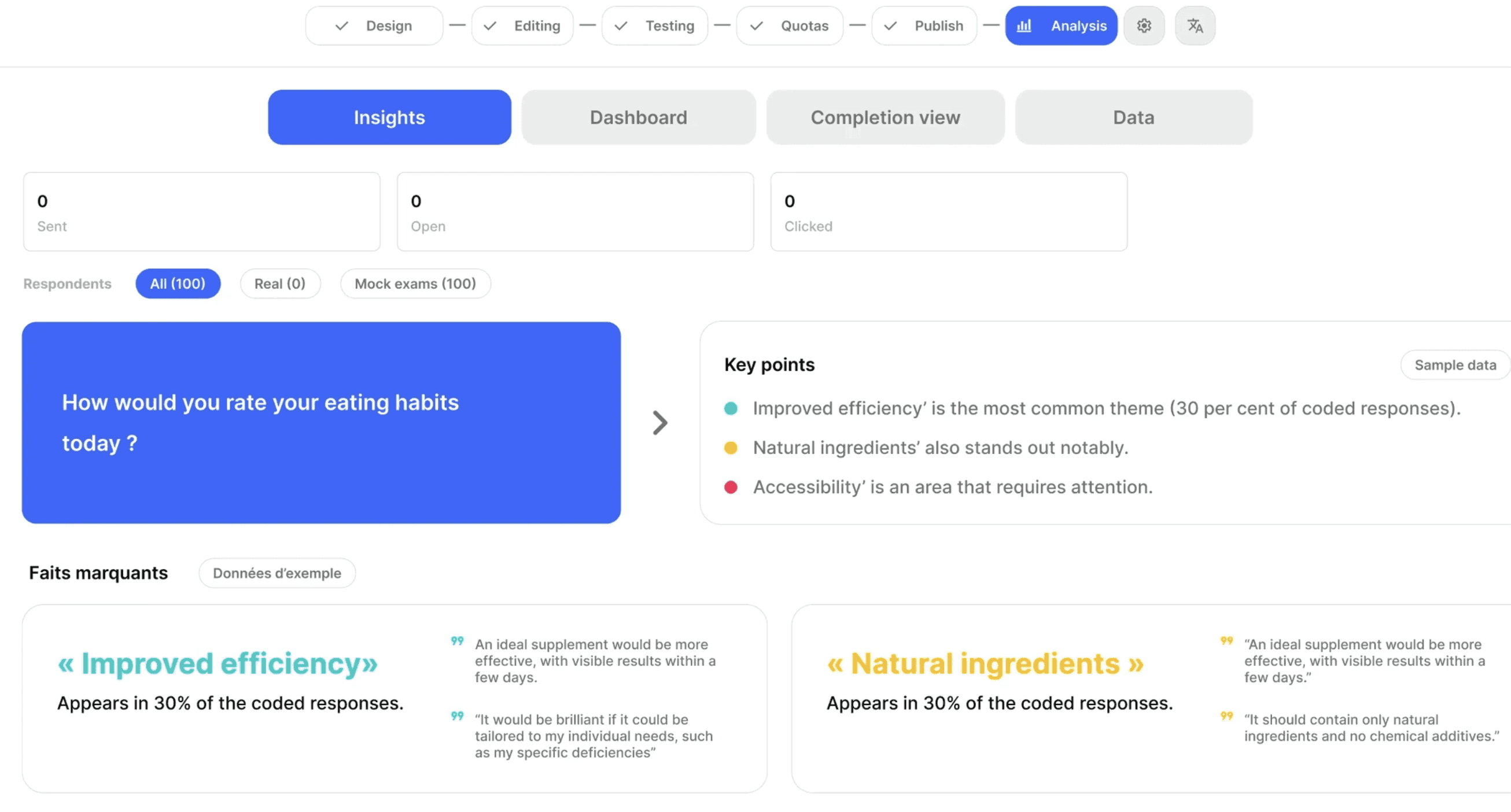
    Analyze quantitative and qualitative insights

    Compare brands on the funnel and read the reasons behind each preference.

Example studies

SmartInterview analysis of coded open answers
Customer story

A personalised-supplement brand facing established competitors

Challenge

A personalised-supplement brand needed to know its buyer personas and how it differed from three established competitors in Germany and Switzerland.

Research design

Consumer survey on category usage, brand perception and differentiators, with AI follow-ups, in German.

Respondents

More than 250 respondents across Switzerland and Germany.

Business decision

The brand refined its positioning for the German and Swiss markets.

Key insights

  • Key buyer personas were validated
  • The brand's differentiators versus competitors were confirmed

Competitor research topics teams search for

Win-loss analysis

Win-loss analysis asks recent buyers why they chose you or a competitor, ideally soon after the decision. Covering both won and lost deals avoids hearing only from happy customers, and coding the reasons shows patterns individual sales calls miss.

Brand switching survey questions

Ask which brand respondents used before, what made them change, how long they considered it and what nearly stopped them. For current competitor customers, ask what would have to happen for them to switch.

Share of wallet research

Share of wallet measures how much of a customer's category spend goes to each brand. It reveals customers who buy from you but give most of their budget to a competitor, and an open follow-up explains why.

Perceptual mapping

A perceptual map plots brands on the attributes buyers care about, such as price and quality, based on how respondents rate each brand. It shows crowded positions and the gaps no competitor owns yet.

Competitive benchmarking survey

A benchmarking survey rates your brand and competitors on the same attributes, with the same scale and sample. Repeating it each year shows whether a gap is closing, and the open answers explain what changed.

How to analyse competitor reviews

Online reviews show what competitors' customers praise and complain about, but they over-represent extreme opinions. Use them to build hypotheses, then test those in a survey with a balanced sample of category buyers.

Unaided brand consideration

Ask which brands respondents would consider before showing any list, then show the list for aided consideration. The unaided answer is the stronger signal, because it shows which brands come to mind at the moment of choice.

Researching a competitor's product launch

When a competitor launches, survey category buyers on awareness of the launch, first impressions and whether it changes their plans. Running the study within weeks catches reactions before they settle into habits.


Pricing

Choose your respondent volume

Pro and Ultimate prices update instantly as you change the number of respondents per month.

300 respondents / month
CHF 79
Pro / month

FREE

CHF050 respondents included
  • 1 member
  • 50 respondents
  • Automated survey design
  • AI-powered analysis & dashboard
  • Share surveys via link, WhatsApp or QR code
Get started for free
RECOMMENDED

PRO

CHF79/ month

starting at 150 respondents

  • Everything in Free, plus:
  • Access to 300 respondents per month
  • Up to 3 members
  • Email invitations
  • Client / externals collaboration
  • AI-powered analysis of open-ended responses
Get started· CHF 79

ULTIMATE

CHF149/ month

starting at 500 respondents

  • Everything in Pro, plus:
  • Access to 500 respondents per month
  • Up to 5 members
  • Qualitative interview transcription
  • Advanced coding & categorisation
  • Company branding
  • Remove SmartInterview branding
  • Executive report with results (PDF)
Get started· CHF 149

ENTERPRISE

Let's talk
  • Everything in Ultimate, plus:
  • Unlimited members
  • Custom respondent volumes
  • Custom integrations
  • Dedicated support
  • Security & procurement review
Contact us

Whether you collect one respondent this month or ten next quarter, you only pay for what you use. Your respondent credits are valid for 3 years.

Frequently asked questions

Competitor research studies how buyers perceive and choose between you and your competitors, to understand where each brand wins and what would make buyers switch.

Ask category buyers which brands they know and consider, which one they prefer and why, and what would make them switch, then compare brands on each step.

Yes, by screening category buyers on the brand they use, through a panel partner or your own prospect lists.

Usually three to six. Enough to cover the brands buyers actually consider, few enough to keep the questionnaire short.

Competitive analysis compares companies from the outside. Competitor research asks buyers how they see those companies.

Around 150 to 300 category buyers give a reliable comparison between brands.

The first 50 respondents are free. Paid plans start at CHF 45 per month for 150 respondents per month.

A study can be live the same day, with results within days.

Find out why buyers pick someone else

List your competitors and ask the buyers who choose between you.

No credit card50 free respondentsGDPR & CCPA compliant